
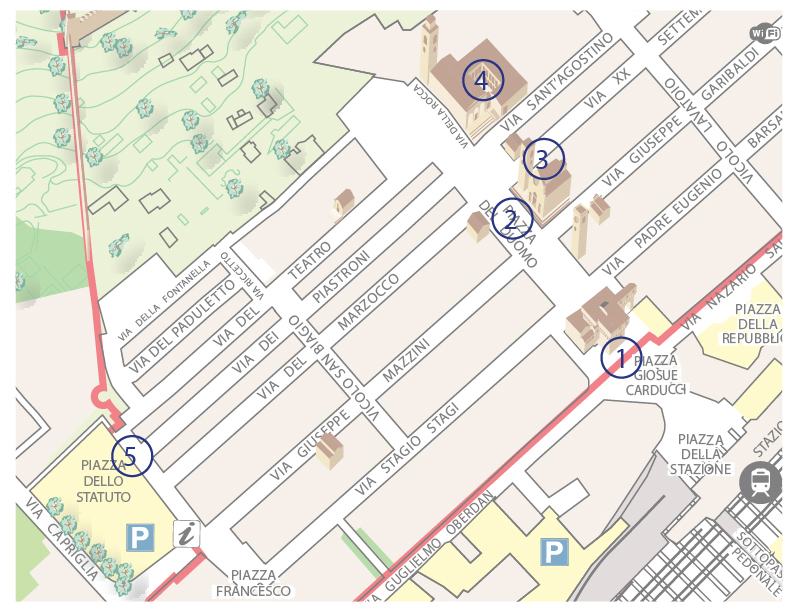
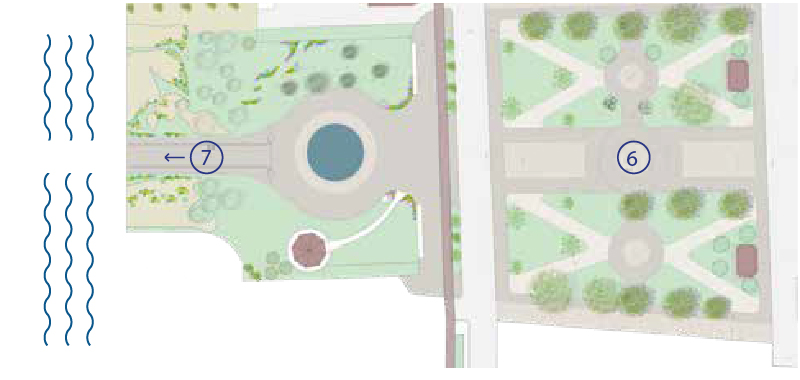
1 Piazza Carducci 2 Piazza del Duomo 3 Piazzetta San Martino 4 Complesso di Sant’Agostino 5 Piazza dello Statuto
6 Piazza XXIV Maggio 7 Pontile
Between marble, bronze, and mirrored steel, the environment and space come alive with a striking tension in the summer of 2026 in Pietrasanta. Chasing the invisible movement of air, water, and wind, the sculptures of Gustavo Vélez rise over a challenge that is simultaneously poetic and formal: transforming the gravity of matter into an experience of lightness.
In a continuous metamorphosis of full and empty spaces, the sculptures expand and thrust upward, suspended in a moment of equilibrium between multiple dimensions. The formal perfection of the square and the circle inscribed within it is both the starting point and the arrival point of this path, where geometry is never cold abstraction but a premise for creating living matter, traversed by energy and movement.
In Pietrasanta, creative laboratory and chosen place for Vélez, this equilibrium takes on an even deeper meaning. It is an equilibrium between sea and mountain, between the moving horizontality of the water and the powerful verticality of the Apuan Alps; between the strength of the stone and the changing flow of light and wind; between the tradition of artisanal excellence and contemporary language. Here, suspended between gravity and weightlessness, the sculptures of Gustavo Vélez trace the dimensions of equilibrium, granting us a profound sense of freedom.
Exhibition Curator
Gustavo Vélez was born in Colombia in 1975. He lives and works between Medellín, where he creates his steel sculptures in his studio, and Pietrasanta, where since 1996 he has developed most of his sculptural production in marble and bronze, in dialogue with the region’s artisanal tradition.
His passion for sculpture emerged in childhood. Fascinated by working with clay and other materials, he soon realized that his path would be connected to art. During his secondary school years, he combined his academic studies with sculpture courses at the Institute of Fine Arts of Medellín, already defining a clear artistic direction. At the age of nineteen, he moved to Florence to continue his education in art history, drawing, and sculpture at the Lorenzo de' Medici School, later settling in Pietrasanta, where he further refined his marble-working techniques at the Palla Cavalier Ferdinando workshop.
After an initial figurative phase, his artistic language evolved toward an abstract universe of pure geometric forms executed in marble, bronze, and steel. These sculptures seem to float in space, apparently weightless, engaging with light and perspective through cubes, prisms, and essential volumes capable of conveying the dynamism and harmony of form, achieving an extreme synthesis of balance, movement, and abstraction.
His research revolves around the exploration of form in space through a process of progressive formal reduction that leads to the stylization of shape. This practice draws inspiration from elements of nature while also being rooted in the history of the twentieth-century avant-garde movements. In continuity with Constructivism and modern European sculpture, Vélez frees form from representation to focus on structure, rhythm, and spatial relationships. His works take shape as sculptural volumes in which matter itself becomes the protagonist, in a constant dialogue between solid and void, stillness and dynamism, monumentality and lightness.
By the late 1990s, organic traces began to emerge from his geometric forms, bringing attention back to the material from which they are made: soft, polished surfaces, often compressed or expanded, crossed by tensions that challenge their plastic form with a distinctly contemporary sensibility.
In 2013, he exhibited for the first time in the iconic Piazza del Duomo in Pietrasanta and at the Sant’Agostino Complex, presenting monumental sculptures in marble, bronze, and steel. On that occasion, he donated the maquette of the work Hipercúbicos, now part of the permanent collection of the Museo dei Bozzetti. Even on a monumental scale, Gustavo Vélez’s works preserve the simplicity and elegance of primitive sculpture. Dynamic forms appear to rise upward, defying gravity and elevating matter toward infinity.
In Tuscany, he has also exhibited at venues including the Parco della Versiliana, Marina di Pietrasanta, and the Marino Marini Museum in Pistoia. Other exhibitions in Italy have taken place in the cities of Lucca, Forte dei Marmi, and Viareggio.
Over the last twenty years, Gustavo Vélez has exhibited internationally throughout the Americas, Europe, and Asia, establishing a significant presence within the contemporary sculpture scene. His work is particularly rooted in the Asian context, with exhibitions in China, Japan, Korea, the United Arab Emirates, and Singapore. In China, he has exhibited in important museum institutions, including the Imperial City Museum of Zhengzhou, and several of his monumental sculptures have entered the permanent collections of cities such as Shenzhen and Nanjing, reflecting a longstanding dialogue with the region.
Among his major solo exhibitions dedicated to monumental sculpture are: Monumentalis (2011–2012), a traveling exhibition hosted by numerous museum institutions in Ecuador and Colombia (the Archaeological and Contemporary Museum of Guayaquil, the Museum of Modern Art of Cuenca, the Museum of Modern Art of Quito, and the Tolima Art Museum in Colombia); Gustavo Vélez. Cartagena de Indias, Colombia (2015–2016); Gustavo Vélez, Musée Bernard Boesch (2021), Le Pouliguen, France; and Forms and Rhythms in the Geometric Dimension, Dominican Republic (2022–2023), featuring works installed at UNESCO World Heritage sites in Santo Domingo, at the Museum of Modern Art of Santo Domingo, and in the iconic cultural complex of Altos de Chavón in La Romana.
In 2023, Vélez was the only Latin American artist invited to the Sculpture Triennial of Bad Ragaz (Switzerland) and Vaduz (Liechtenstein), one of Europe’s most important exhibitions of monumental sculpture.
In 2025, the artist presented his monumental work in Monterrey, Mexico, exhibiting large-scale sculptures in steel, bronze, and marble. The exhibition, originally installed in Fundidora Park, is currently on view at the renowned Rufino Tamayo Park.
In 2024, Gustavo Vélez received the Fratelli Rosselli Prize in Italy, a prestigious award presented to artists who uniquely represent the city of Pietrasanta around the world.
In Colombia, his country of origin, he has received important institutional honors, including the Order of the Grand Knight and the Simón Bolívar Order of Democracy, awarded by the Congress of the Republic for his contribution to the international promotion of Colombian art. These distinctions are complemented by awards granted by the Government of the Department of Antioquia—including the Gold Star of Culture and the Marshal Jorge Robledo Order of Civic and Entrepreneurial Merit—and, in 2019, honors conferred by the City of Medellín, such as the Porfirio Barba Jacob Medal and the Don Juan del Corral Order of Merit, both in the Gold Grade.
Gustavo Vélez’s works are part of numerous permanent collections in public and private institutions around the world. Among the most significant are Hiki Hospital in Utsunomiya and Akasaka Palace in Tokyo, Raffles Hotel Shenzhen and The Ritz-Carlton Nanjing, the Museum of Contemporary Art of Guayaquil, Art Valley Seoul, and, in Pietrasanta, the Museo dei Bozzetti and the Versilia highway interchange area.
Major private and institutional collections include the Marriott Hotel Panama, Banco BHD, the Museum of Modern Art of the Dominican Republic, and the headquarters of Apple Inc. in San Diego, California. In Colombia, his sculptures are featured in numerous public and institutional spaces, including the Pontifical Bolivarian University and several stations of the Medellín Metro system, as well as public parks and museums such as the Tolima Art Museum in Ibagué.